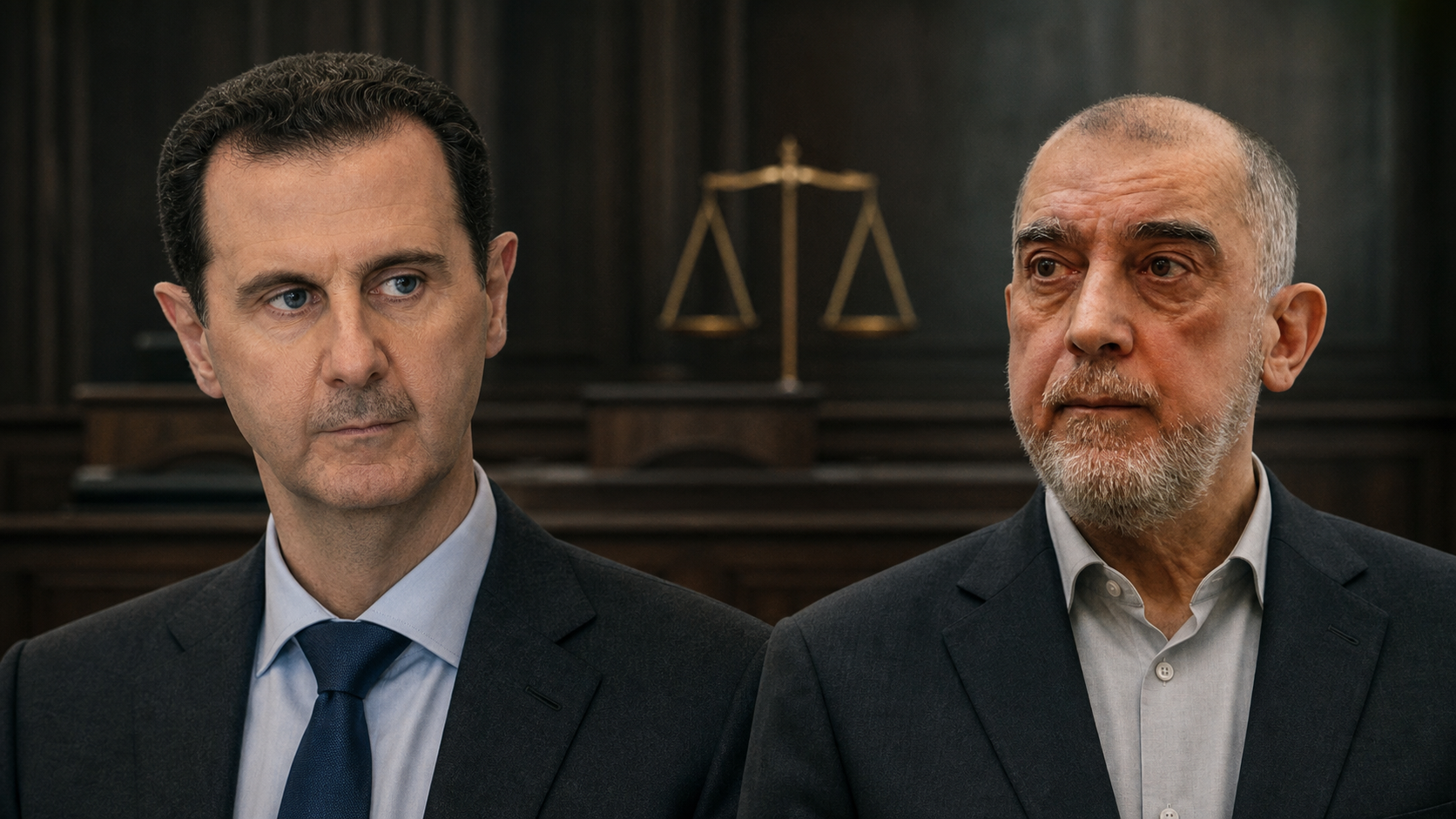
The significance of the Damascus judgment lies not only in the severity of the sentence, but in the fact that it constitutes the first public test of the Syrian judiciary’s ability to move from an era in which State institutions protected the accused to one in which senior officials are supposed to be subject to law. Yet the justice of the cause, however clear it may be in the public conscience, does not relieve the court of proving each person’s responsibility individually, nor does it place judicial proceedings beyond criticism.
On 11 August 2026, the Fourth Criminal Court in Damascus issued death sentences in proceedings involving Atef Najib, the former head of the Political Security Branch in Daraa, along with Bashar al-Assad, Maher al-Assad and a number of other former senior officials. According to published information, Najib attended the trial and heard the verdict in the courtroom, while the judgments against al-Assad and the other fugitives were delivered in absentia. The acts attributed to the defendants included premeditated murder, torture and crimes against humanity.
This moment carries enormous weight in Syria’s collective memory. Atef Najib’s name has long been associated with the arrest and torture of children in Daraa and with the repression of the first protests in 2011. Bashar al-Assad, meanwhile, was not merely a political official remote from events, but the head of a military, security and administrative structure that operated for years in an organised hierarchy. Nevertheless, moving from broad historical truth to individual criminal conviction requires more than the clarity of the political picture. It requires specific evidence, a coherent legal theory of responsibility, and a reasoned judgment explaining how each act was attributed to each defendant.
First: One Judgment in the Headlines, but Different Legal Positions
Media headlines may place Atef Najib and Bashar al-Assad in the same story, but the law does not treat their procedural positions in the same way.
Atef Najib was tried in person and was, in principle, able to learn the charges, confront the evidence and obtain legal representation. The presiding judge also stated that the judgment could be appealed. The ultimate legal value of his case will therefore depend not only on the first-instance verdict, but also on the seriousness of the appeal process, the defence’s ability to review and challenge the evidence, and the willingness of the Court of Cassation to address any defect in procedure or reasoning.
Bashar al-Assad, Maher al-Assad and the other fugitives were convicted in absentia. Such judgments carry considerable judicial and political significance and may provide a national basis for pursuing the defendants, tracing their assets and requesting international cooperation. But an in-absentia judgment is not equivalent, in guarantees or legal effect, to a judgment issued after the accused has appeared and confronted the evidence. If any person convicted in absentia is arrested or extradited, the law must provide a genuine opportunity for retrial or an effective challenge—not a merely formal review of a conclusion already fixed in public discourse.
This distinction does not diminish victims’ rights; it protects the judgment itself. The more serious the case and the higher the accused’s office, the greater the need for a decision that cannot later be defeated by a procedural flaw that could have been avoided.
Second: Were the Acts Tried as Ordinary Crimes or International Crimes?
The case brings together offences familiar to domestic criminal law, including premeditated murder, torture and unlawful deprivation of liberty, with the classification of crimes against humanity. The latter belongs to international criminal law and requires proof of a broader context: a widespread or systematic attack directed against a civilian population, the connection of the accused’s acts to that attack, and the accused’s knowledge of its context.
It is not enough for the court simply to include the international classification in the operative part of its judgment. It must explain the legal source of the rule applied, address the principles of legality and non-retroactivity, and establish the legal, material and mental elements of each offence. Syrian legal analyses issued since the beginning of Najib’s trial have already stressed the need to ground the judgment clearly in Syrian law and customary international law, rather than merely invoking international labels without detailed legal construction.
The court must also distinguish among different modes of responsibility. Responsibility for issuing a direct order is not the same as contributing to a common plan, and neither is identical to command responsibility arising from knowledge of subordinates’ crimes and failure to prevent or punish them. Bringing several defendants into one case does not permit the same evidence to be attributed to all. The judgment must identify each person’s position in the chain of decision-making, what that person knew, what they did or failed to do, and the link between their conduct and the criminal result.
Third: A Fair Trial Is Not a Privilege Granted to the Accused
When the defendants’ names are associated in the Syrian public conscience with torture, killing and enforced disappearance, discussion of defence rights may appear offensive to some victims. But a fair trial is not a moral reward granted to those considered worthy of it and withheld from others. It is a limitation on State power and a safeguard against the return of an instrumentalised judiciary.
Concerns raised about the pace of the proceedings, the adequacy of legal representation and the extent to which certain testimony directly connected Najib to the charged conduct must therefore be treated seriously. The proper answer is not to accuse those raising such concerns of defending the former regime. It is to publish the full reasoned judgment, provide a transparent record of the proceedings, explain how the evidence was assessed and allow the defence to pursue a genuine and effective appeal.
The former regime sentenced opponents through exceptional courts, relied on coerced confessions and emptied the right of defence of substance. A new Syria cannot claim that safeguards matter when the accused is weak but become dispensable when the accused is widely despised. The real test of the rule of law is the ability to apply its rules when public pressure is at its highest.
Fourth: The Death Penalty Does Not Exhaust the Meaning of Justice
The death sentences give the event immense emotional and symbolic weight. The feelings of victims and their families after years of denial and impunity cannot be dismissed. Yet the harshness of a penalty is not the sole measure of successful justice, and it must not eclipse questions about the soundness of the conviction, judicial independence and appeal rights.
Syrian law retains capital punishment, while international human-rights law increasingly restricts its use, and international human-rights organisations oppose it in all circumstances because it is irreversible and cannot be corrected once carried out. Syria will need a separate and careful debate about this tension: how can victims of exceptionally grave crimes be given justice without making execution the sole measure of the State’s seriousness? How should the law currently in force be reconciled with the growing international movement towards abolition?
These questions do not lessen perpetrators’ responsibility. They recognise that transitional justice is broader than physical punishment. It includes truth-seeking, clarifying the fate of the disappeared, restitution of property, reparations, preservation of memory, institutional reform and guarantees of non-recurrence.
Fifth: What Follows from the In-Absentia Judgment Against Bashar al-Assad?
The judgment does not place Bashar al-Assad immediately within the reach of Syrian justice. Enforcement depends on his arrest or extradition—a matter governed as much by politics and international relations as by rules of judicial cooperation. A State where a fugitive is present may refuse extradition for legal or political reasons, particularly where the request is linked to capital punishment or concerns are raised about fair-trial guarantees.
The judgment is not, however, without legal effect. If it satisfies the relevant standards, it may support the issuance or updating of arrest warrants, mutual legal-assistance requests, and measures to trace funds and assets connected to those convicted. It may also become part of a national judicial record supporting later proceedings, provided it is presented to other States not as a political declaration but as a reasoned, evidence-based judgment capable of scrutiny.
International cooperation must not be reduced to extradition. Archives, banking information, assets, companies and intermediaries are located across several jurisdictions. Effective justice requires precise legal files for each asset and each defendant, coordination between the judiciary and asset-recovery bodies, protection of bona fide third parties, and guarantees that recovered funds will be directed towards repairing harm suffered by Syrians.
Sixth: What Does the Judgment Say to Victims?
For many Syrians, seeing a former senior security official in the dock amounts to belated recognition that victims’ accounts were neither exaggeration nor political propaganda. That recognition matters. But victims must not be asked to treat the judgment as the end of the case.
A victim’s right is not confined to witnessing punishment. Victims have a right to the full truth: who issued the orders, who implemented them, where the records are held, what happened to the disappeared, who seized property, and why prosecutors, courts and oversight institutions failed to stop the crimes. Victims are also entitled to participation, information about the progress of proceedings, protection against reprisals and adequate reparation.
Accountability focused on a small number of prominent names may give the State a rapid image of achievement, but it does not expose the institutional network that made the crimes possible. The judgments against Najib and al-Assad must therefore not replace proceedings against other responsible individuals, nor become a pretext for closing the files of detainees, the disappeared, the displaced and unlawfully seized property.
The Position of the Free Syrian Lawyers Association
Samer Aldeyaei, Executive Director of the Free Syrian Lawyers Association, said: “The appearance of Atef Najib before the judiciary and the issuance of a judgment against Bashar al-Assad represent a moment of profound significance for victims and for Syrians who waited many years for accountability to begin. But the justice of the cause and the gravity of the crimes do not relieve the judiciary of its obligation to comply fully with fair-trial guarantees, provide reasoned judgments, enable an effective defence and preserve avenues of appeal. We do not seek exceptional trials that replace one injustice with another. We seek an independent judiciary that uncovers the truth, establishes individual and command responsibility, and delivers judgments for victims that can withstand both law and history.”
He added: “This judgment must not become a symbolic conclusion to the file of crimes. It should be the beginning of a process that includes clarifying the fate of the disappeared, protecting evidence and witnesses, recovering Syrians’ assets, and prosecuting all those responsible for grave violations without selectivity. Transitional justice is not measured by the number of death sentences, but by its ability to dismantle the architecture of impunity and prevent recurrence.”
Seventh: What Must Happen Now?
- Publish the full reasoned judgment: Victims, lawyers and researchers must be able to assess its legal basis, evidence and modes of responsibility.
- Guarantee an effective appeal for Atef Najib: He must have counsel capable of engaging with the case, adequate time to prepare, and a court willing to review fact and law seriously.
- Guarantee retrial for those convicted in absentia if arrested: They must be able to confront the evidence and present a defence without erasing the documentary value of earlier proceedings.
- Preserve evidence and archives: Security, prison and court records must be protected from tampering, and individual cases connected to a broader map of chains of command.
- Protect victims and witnesses: Information that may expose them or their families to danger must remain secure.
- Separate adjudication from political messaging: Judgments must not become tools for demonstrating the authorities’ legitimacy or managing public sentiment.
- Expand accountability without selectivity: Proceedings must cover perpetrators of grave crimes regardless of position or affiliation.
Conclusion: The Judgment Begins the Test; It Does Not End It
The judgments against Atef Najib and Bashar al-Assad are difficult to understate in symbolic importance. For the first time, names once surrounded by immunity have entered a Syrian judicial ruling addressing murder, torture and crimes against humanity. But the historical value of the decision will not be determined on the day it was announced. It will be determined by what institutions do next.
If the judgment is published with its reasoning, appeal rights are protected, each defendant’s responsibility is distinguished, and the proceedings are used to open archives, clarify the fate of the disappeared, recover assets and reform the judiciary, this moment may become the beginning of a genuine national accountability process. If justice is reduced to the image of the dock and the pronouncement of death, while questions about evidence, defence and other perpetrators are closed, Syria will have achieved a symbolic victory that remains insufficient to build the rule of law.
Syrians waited a long time to see powerful defendants before a court. Today they are entitled to demand more than a severe sentence: an independent judiciary, the whole truth, and justice that does not fear scrutiny because it knows that it rests on law.