A Preliminary Documentary and Legal Briefing
On 5 August 2013—sixteen days before the large-scale chemical attack on Eastern and Western Ghouta—the towns of Adra and Douma in the Damascus countryside were struck by toxic chemicals believed to have been sarin-like nerve agents. Despite its gravity, the incident has received far less public attention than the massacre of 21 August. At the time, however, it was the largest documented chemical attack in Syria and an early warning of the far deadlier assault that followed.
This article is neither a judicial ruling nor a substitute for a competent criminal investigation. It is a preliminary documentary and legal briefing that distinguishes between facts supported by testimony and open-source material, and individual criminal responsibility, which can be determined only by an independent court. It also introduces a second article that the Free Syrian Lawyers Association (FSLA) will publish on 21 August, marking the thirteenth anniversary of the major Ghouta chemical massacre.
1. What Happened in the Early Hours of 5 August?
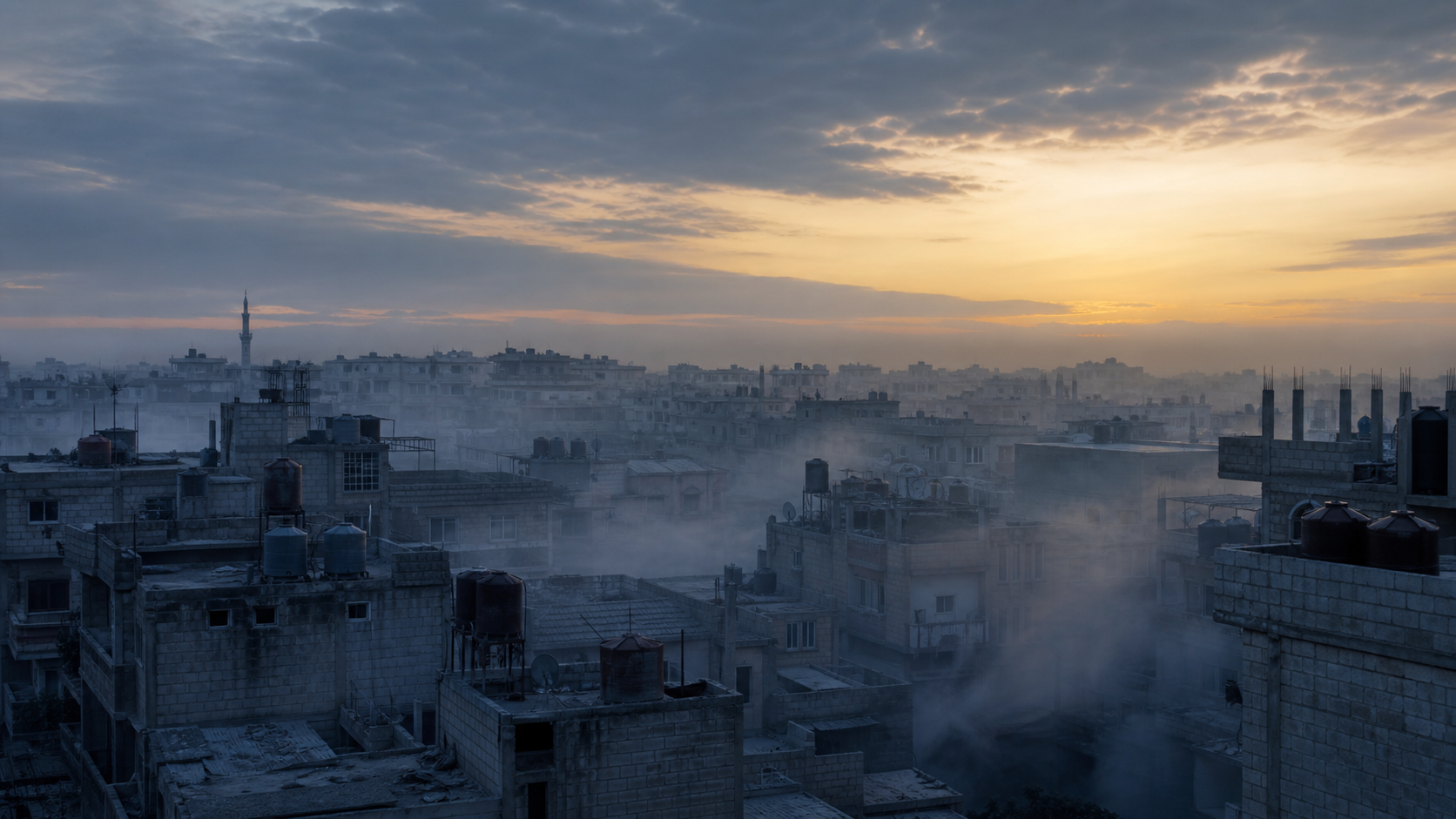
According to documents and testimony submitted in the French judicial investigation, toxic chemicals struck the industrial town of Adra at approximately 1:00 a.m. and the larger city of Douma at around 5:00 a.m. Survivors and doctors described civilians suffering from suffocation, breathing difficulties, impaired consciousness and symptoms consistent with exposure to a nerve agent. In Douma, some residents moved towards rooftops in an attempt to escape chemicals that remained closer to the ground, while field hospitals and medical points were overwhelmed by casualties.
Materials filed in the French proceedings indicate that more than 400 people were injured in Douma, including women and children. The sources reviewed for this article do not provide a single, reliable final death toll for this specific incident. Figures should therefore not be repeated without adequate verification or confused with the casualty figures from 21 August. Accuracy is not a merely technical precaution: it is part of respecting victims and protecting the integrity of any future judicial process.
2. A Separate Attack That Must Not Be Confused with Douma in 2018
Three distinct incidents are frequently conflated in public discussion:
- The Adra and Douma chemical attack of 5 August 2013, which is the subject of this article.
- The chemical attack on Eastern and Western Ghouta on 21 August 2013, in which sarin was used on a large scale and large numbers of civilians were killed or injured.
- The Douma attack of 7 April 2018, which was investigated separately by the Organisation for the Prohibition of Chemical Weapons. Its Investigation and Identification Team concluded that there were reasonable grounds to believe that the former Syrian Arab Air Forces carried out the attack using chlorine gas.
Distinguishing these events is essential. Each has its own date, evidence, operational context and legal file. Credible documentation begins with an accurate place, time and description of the evidence; it cannot be built by merging separate incidents under a single general label.
3. What Does the Available Evidence Show?
Human Rights Watch reviewed photographs and videos from 5 August that appeared to show remnants of a rocket measuring approximately 330 mm, with features consistent with a munition suspected of being designed to carry chemical agents. These included an additional filling plug and red numbering. The footage also showed dead or dying animals without apparent physical injuries and displaying signs consistent with exposure to a nerve agent.
Human Rights Watch nevertheless stated that it could not independently confirm, on the basis of those materials alone, the allegation concerning the party responsible for the 5 August attack. This qualification does not deny that the incident occurred or render the material irrelevant. It defines the proper evidentiary limits of individual items and underlines the need to assess them together with survivor testimony, medical records, military documents and command-structure evidence.
In the French investigation subsequently opened into the attacks of 5 and 21 August 2013, Syrian and international organisations submitted hundreds of additional items, including photographs, videos, maps identifying impact locations and documents concerning military structures and chains of command. According to the Syrian Center for Media and Freedom of Expression, one submission included 491 additional evidentiary items and direct testimony from 61 witnesses and survivors, as well as defectors’ testimony and information concerning military units and institutions allegedly connected to the chemical weapons programme.
The volume of material does not by itself establish criminal responsibility. Its legal weight depends on authenticity, chain of custody, verification, corroboration and the ability of the defence to challenge it before an independent tribunal. Nevertheless, preserving, organising and transmitting this evidence to competent authorities has prevented the loss of an essential part of Syria’s evidentiary record.
4. The Legal Prohibition Existed Before Syria Joined the Convention
Syria acceded to the Chemical Weapons Convention in October 2013, after the attacks of 5 and 21 August. This does not mean that chemical weapons were legally permissible before accession. Syria was already a party to the 1925 Geneva Protocol, and the prohibition on the use of chemical weapons in armed conflict was firmly established as a rule of customary international law.
International humanitarian law prohibits poison and poisoned weapons, as well as means of warfare that cannot be directed at a specific military objective or that are inherently indiscriminate in their effects. The deliberate use of a toxic chemical against a populated area may constitute a war crime. Where it forms part of a widespread or systematic attack directed against a civilian population, and the required knowledge is established, it may also amount to a crime against humanity.
Responsibility is not necessarily limited to the person who launched a munition. Subject to the requirements of criminal law, it may extend to those who planned, ordered, assisted or supplied the means, and to commanders who knew or should have known that subordinates were committing crimes and failed to take necessary and reasonable measures to prevent or punish them. Such responsibility is individual: no institution, community or social group may be convicted in place of proving the conduct and intent of identified persons through admissible evidence.
5. The French Investigation: Judicial Progress and Procedural Limits
In March 2021, survivors and human-rights organisations filed a complaint in France concerning the sarin attacks in Adra, Douma and Ghouta. In April 2021, France’s specialised unit for crimes against humanity and war crimes opened a judicial investigation into the incidents as potential war crimes and crimes against humanity. Two investigating judges began examining the alleged responsibility of officials in the former Syrian government within a broader pattern of attacks on areas then held by opposition forces.
In November 2023, arrest warrants were issued for Bashar al-Assad and several former senior officials in connection with their alleged roles in the chemical attacks. On 25 July 2025, however, the Plenary Assembly of the French Court of Cassation annulled the warrant issued for Assad. It held that he had been a serving head of state when the warrant was issued and therefore enjoyed personal immunity before the domestic courts of a foreign state at that time.
The judgment must be read precisely. The Court did not find that the attacks had not occurred, acquit any suspect, or declare the use of chemical weapons lawful. Its ruling addressed the validity of a specific warrant under the rules of immunity applicable when it was issued. It did not close the investigation and does not, in principle, prevent proceedings against other officials or new judicial measures where the relevant legal conditions are met.
This distinction between immunity and responsibility is fundamental. Immunity is a procedural limitation on the exercise of jurisdiction in defined circumstances; it does not erase an incident or negate substantive responsibility. At the same time, the gravity of an alleged crime cannot justify abandoning fair-trial guarantees. A credible justice process must protect both victims’ right to an effective remedy and an accused person’s right to mount a genuine defence before an independent court.
7. What Must a Syrian Transitional Justice Process Do?
Chemical-weapons crimes cannot remain the exclusive concern of foreign courts. Any credible Syrian transitional justice process must treat them as a priority without turning the file into an instrument of revenge or political bargaining. At a minimum, this requires:
- Creating a unified national register of chemical attacks that distinguishes each incident by date, location, victims and evidence.
- Protecting digital originals, medical records, munition remnants and chains of custody in a manner that preserves their potential judicial use.
- Providing effective protection for survivors, witnesses, doctors and documenters, and preventing disclosure of their identities or data without consent.
- Establishing specialised investigative and prosecutorial teams combining criminal, medical, military and international-law expertise.
- Ensuring that victims and their families participate in the design of truth, accountability and reparation mechanisms, rather than being treated only as sources of information.
- Rejecting any general amnesty that covers war crimes or crimes against humanity or obstructs victims’ access to justice.
- Cooperating with the OPCW, United Nations mechanisms and foreign judicial authorities while safeguarding the independence of Syrian judicial decision-making.
8. Between Memory and Evidence
An anniversary should not become an occasion to reproduce victims’ images unnecessarily or consume survivors’ suffering in seasonal rhetoric. Its legal and ethical purpose is to preserve the names of those affected, remind us that every technical file represents lives permanently altered, and resist denial and manipulation of the chronology of crimes.
Memory, however, cannot replace proof. Justice is not built on predetermined political certainty, but on an independent investigation that establishes what happened, how it was carried out, who issued orders, who supplied the means and who attempted to conceal evidence. Insisting on these standards is not accommodation of suspects; it is what makes any eventual judicial decision stronger, more legitimate and less vulnerable to challenge.
A Prelude to the 21 August File
The 5 August 2013 attack is not a footnote in the history of chemical weapons in Syria. It is a distinct incident deserving documentation and recognition, and an early episode in a pattern that culminated sixteen days later in Eastern and Western Ghouta. Ignoring it denies its victims their place in public memory and weakens our understanding of how the attacks, decision-making structures and international responses developed.
On 21 August, FSLA will publish the second article in this file, examining the major Ghouta chemical massacre: what did the United Nations investigation establish, how did international law respond, and why has accountability remained far below the level warranted by the facts and evidence thirteen years later?
FSLA’s Documentary and Legal Contribution
The Free Syrian Lawyers Association (FSLA) treats documentation as a long-term legal responsibility, not as a media activity limited to anniversaries. Within its professional capacity and networks, FSLA works to gather available legal information, review open sources, preserve accounts and facts relating to grave violations, and turn fragmented material into knowledge that can support public legal education, research and accountability processes.
FSLA does not claim that its work replaces criminal investigations, forensic expertise or the mandates of specialised international bodies. Its role is to help protect Syria’s legal memory, improve the accuracy of terminology and timelines, and connect documentation to victims’ rights and fair-trial requirements. Subject to confidentiality, data-protection and witness-safety safeguards, FSLA also supports professional cooperation with independent and impartial Syrian and international bodies working to establish the truth and determine individual responsibility.
Publishing this file is part of a broader FSLA effort to keep chemical-weapons crimes present in Syrian legal debate, to resist reducing them to numbers or annual commemorations, and to advocate for a national policy that preserves evidence, recognises survivors and places accountability and reparation at the centre of transitional justice.
Selected References:
- Q&A on the French chemical-weapons case – Open Society Justice Initiative and partners
- Developments in the investigation and evidence submitted – Syrian Center for Media and Freedom of Expression
- Attacks on Ghouta and analysis of delivery systems – Human Rights Watch
- French Court of Cassation ruling, 25 July 2025
- OPCW report on the 7 April 2018 Douma attack, cited to distinguish the incidents
This article was prepared for documentation and legal public education. It does not constitute a final determination of any person’s criminal responsibility. The presumption of innocence and fair-trial guarantees remain applicable until a competent court issues a final judgment.